


3rd Quarter 2026 Market Outlook
To begin this quarter’s market commentary, we are going to recap what we said in Q1 2026 and will likely remain true, and in our commentary for the next few years. Next, we will discuss the recent FED chair appointment, seasonal market cycles, and finally technical analysis.
Political Landscape
I want to begin by reiterating what we stated about the political landscape in Q1 2026:
“At the start of this administration, President Trump emphasized a focus on ‘Main Street, not Wall Street.’ Many initially interpreted this to mean that he would prioritize middle-class economic well-being even at the expense of market performance. Yet, experience has shown that the President is unwilling to let prolonged market weakness persist.
For example, he initially pressed forward with aggressive tariffs but paused once equity and credit markets began to falter. This pattern is consistent: while his methods are often controversial, his actions demonstrate a willingness to support markets when needed. Examples of this include his talk of wanting to do a ‘DOGE dividend’ earlier this year as well as payments to citizens based on the money saved from the tariffs and the tax cuts from the OBBB. The long-term effects of these policies are hard to understand, but in the short run, President Trump is showing his desire to boost the stock markets and the economy overall.”
Trump has not indicated that his commitment to Main Street has changed.
Federal Reserve Changes
June held the first Federal Open Market Committee hosted by the new FED chairman, Kevin Warsh. In this meeting, he expressed, as former FED chairmen have, that the FED remains committed to their two-fold mandate; to keep employment data up and inflation within their target: 2%. While in words and on paper he may seem similar to Jerome Powell (the former FED chairman) in ways, it is still uncertain how he will handle this immense responsibility. Further, although the FED’s stated commitment to their goal remains unchanged, Kevin Warsh majorly changed the tide by nixing the forward guidance the FED historically gave. This lack of forward guidance means the FED may be looking to be more private, acting behind the scenes to support the economy, rather than manipulating the markets with their every word.
Whatever may come with Chairman Warsh, one thing is certain: the markets have varying and sometimes adverse responses to uncertainty. Because of this, we should be cautious in our approach to the markets over the 3rd quarter.
Seasonal Market Cycles
Another factor that may greatly affect the markets is the historical volatility of the summer months. The old adage goes, “sell in May and go away”. This is because typically the markets express less favorable gains between the months of June and September. So far, this summer, we have already seen some of that uncertainty. Further, the effects of the war in Iran are still being realized. Will the higher gas prices cycle through in another wave of across-the-board inflation? Will the situation stabilize in the middle east, at least in a way that stops affecting the broader markets? Will lower gas prices cause consumers to be able to invest more? Anyone who claims to know the answer to these questions is merely guessing; only time will tell. For us at Cornerstone, rather than trying to predict future events, we prefer to construct all-weather portfolios and make minor changes as we see data come in.
Technical Analysis
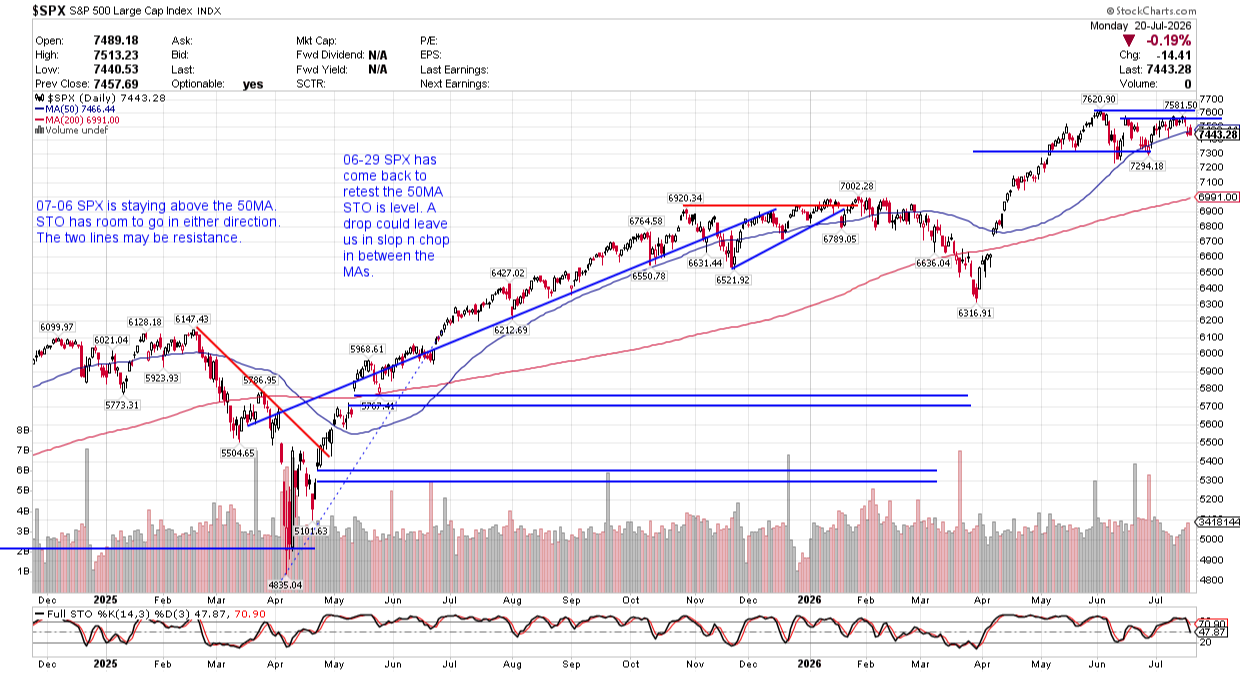
(As of 07-20-2026)
From a technical standpoint, the markets have slowed down a bit and could level out if they continue to break beneath the 50-day moving average. However, there are no major signs to show a bear market is at hand (the only hint at that is the gap around 6600). A potential head and shoulders pattern could take us down to the lower 7,000s range, but I don’t expect we will drop beneath the 200-day moving average.
Conclusion
In conclusion, we are more cautious this quarter than we have been the last two quarters. However, we do not see enough danger to want to decrease our equity position beneath its target. Moving forward, we will rebalance, taking some of the over-inflated equity off the table and increasing the underweighted bond holdings. This discipline of staying fully invested according to our target allocation provides us with the potential to limit downside if things turn for the worse, but still to continue up if the bull market continues.
Bibliography:
Summers, G. (2026a, June 19). Kevin Warsh Just Took 30 Years of Fed Culture to the Wood-Chipper.
OneAscent Financial Services, LLC (“OAFS”), d/b/a The Cornerstone Financial Group, is a registered investment adviser with the United States Securities and Exchange Commission. OAFS does not make any representations or warranties as to the accuracy, timeliness, suitability, completeness, or relevance of any information prepared by OAFS or any unaffiliated third party. OAFS is neither an attorney nor accountant, and no portion of the presented content should be interpreted as legal, accounting, or tax advice. All such information is provided solely for convenience purposes only and all users thereof should be guided accordingly.